The car park at Elmstead Market is half-full on a Tuesday in late May, which is to say it holds eleven cars and a small Ford van advertising a Suffolk plant nursery. Most of the visitors are retired. Three are taking notes in cloth-bound books.
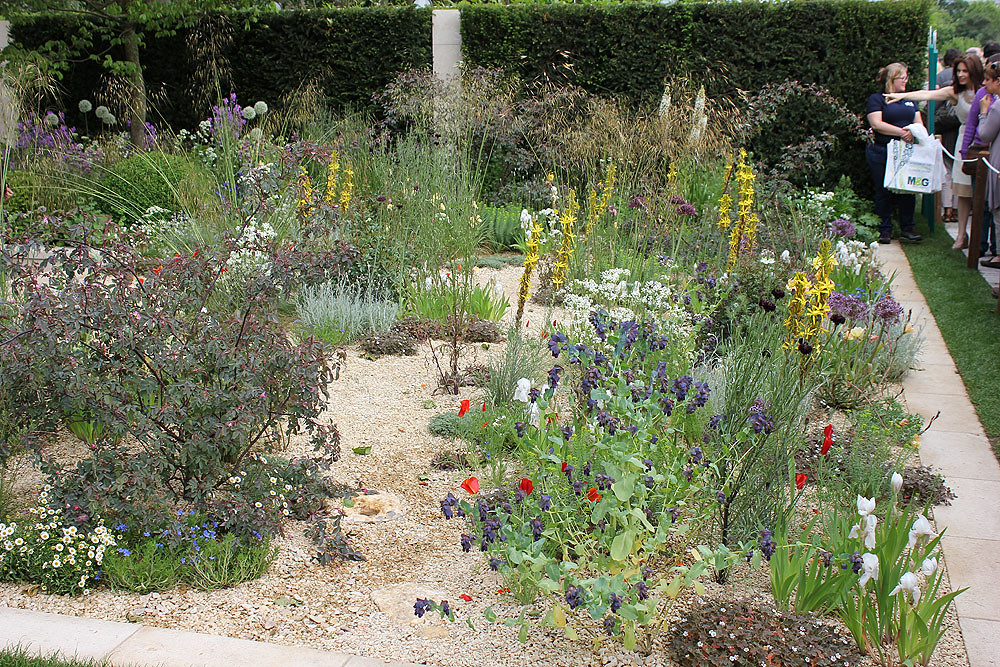
The gravel garden begins immediately past the gate. There is no transition bed, no lawn fronting it. The path is the same gravel as the planting, which is the point.
Beth Chatto laid this garden out in 1991 on the site of the nursery car park, a quarter-acre of compacted shingle that had never been irrigated and, by the founder's instruction, was never to be. The bargain held until her death in 2018, and it holds now, in the third decade since planting.
On the morning of the visit the soil moisture probe at the head of the path reads twelve percent. The lavender is just beginning to bud. Bearded iris stand in clumps three feet across, the flag a sun-faded violet that the head gardener, Asa Brindley, calls Iris pallida and dates to a 1994 division.
Brindley has been at the garden for nine years. She is forty-one, trained at Capel Manor, and speaks of the planting in the third person, as though the garden made itself and she merely keeps it tidy.
Asked what changes she has made since taking over the borders in 2019, she names three. A patch of Stipa gigantea at the eastern end was lifted because it had begun to seed into the Mediterranean section. Two Cistus shrubs that died in the 2022 drought were replaced not with cistus but with Phlomis fruticosa, which she had been watching elsewhere in the garden for fifteen years. The path was re-graded once, in 2021, after a winter that produced an inch of standing water for the first time in living memory.
Otherwise the garden is what it was. The dry-loving plants that Chatto trialled here in the early 1990s, sourced from her own observations of Greek hillsides and the chalk downs of southern England, have lived through twelve heat-dome summers and the freeze of February 2018 that killed half of Norfolk's olive trees.
What is striking, in late May, is how little of the planting is in obvious bloom. Most of the gravel garden's show happens in June and July, when the verbascums spire to seven feet and the eryngiums turn that steel blue that nothing else in the British garden does properly.
In May the garden is mostly texture and foliage. The grey of Artemisia ludoviciana against the near-black rosettes of Sempervivum tectorum. The chalky stems of Euphorbia characias wulfenii holding their lime-green bracts above a low underplanting of thyme.
Brindley stops at a bed she calls the south curve and points to a single ballota, Ballota pseudodictamnus, that she says was planted by Chatto herself in 1993 from a Greek collection. The shrub is now four feet across. It has never been watered.
A visitor in her seventies asks how often the garden is mulched. Brindley says once a year, in March, with a half-inch of fresh pea gravel laid by hand. No compost. No leaf mould. The plants want lean conditions.
The visitor, who introduces herself as Joan Devereaux from a village near Saxmundham, mentions that she has tried a gravel garden of her own and the bindweed has taken over. Brindley nods, says this is the most common failure, and points out that Chatto spent eighteen months before planting removing every perennial weed by hand, then waiting through one full season for any survivors to declare themselves.
It is the kind of patience that has gone out of British gardening, Brindley says, and immediately apologises for sounding like an old woman. She is forty-one.
The tea room sells a small book of Chatto's gardening notes, edited posthumously from her commonplace books and published by the Beth Chatto Foundation in 2024. It costs nine pounds and runs to ninety-two pages. The notes are short, dated, and entirely free of the usual horticultural hectoring.
One entry from August 1996 reads: The verbascum self-seeded into the path. I have moved three. The fourth I will leave to see what it makes of itself.
Walking back through the woodland garden, which Chatto added in the early 2000s and which receives no supplementary water either, the visitor count has risen to perhaps thirty. Many are silent. One man, sitting on a bench near the pond, is reading a book of poems.
There is no shop selling cuttings of the gravel garden's stars. The plants in the nursery yard are conventional retail stock, though Brindley says a small selection of Chatto-collected forms is propagated and sold once a year, in mid-March, to those on the mailing list. The mailing list closed for new members in 2023 and there is a waiting list.
On the way out the visitor passes a row of stock beds where younger members of the nursery staff are pricking out a tray of Allium christophii seedlings. The seed was collected on the property in July of last year.
It is the small continuity that matters, Brindley says. The plants Chatto chose will outlast her, and Brindley, and the next head gardener, if the gravel is replenished and the perennial weeds are kept down.
Whether the lessons translate to a suburban plot in Hertfordshire is a separate question, and one that the garden does not answer.
The drive home through eastern Essex passes three new-build estates whose front gardens are laid to lawn and irrigated by pop-up sprinklers on timers. None of the houses are more than ten years old. None of the lawns look particularly well.