On the 11th of December, 2025, in an 80-square-foot lean-to greenhouse in Northampton, Massachusetts, a former dairy farmer named Owen Whitcher loaded a four-foot steel mesh cylinder with 320 pounds of fresh horse manure, dampened it to roughly 55 per cent moisture, and walked away.
Three days later the centre of the pile reached 142 degrees Fahrenheit. The greenhouse air, on a 19-degree outside night, held at 41. Owen had succeeded, by the technique known as a Jean Pain composting reactor, in heating his small greenhouse without electricity, propane, or any moving part.
Wintergreen visited Owen's greenhouse five times over the following four months, on dates ranging from January 8th to April 3rd. The notes here are taken from those visits and from the temperature log Owen keeps in a school exercise book on a shelf above the door.
The Jean Pain method is named for a French forester who, in the 1970s, demonstrated that a large enough pile of moistened, well-aerated organic matter would self-heat to thermophilic temperatures and remain there for months. Pain used wood chips. Owen uses horse manure mixed roughly 1 to 1 with hay.
The mesh cylinder is welded from galvanised hardware cloth on a frame of half-inch rebar. It is four feet in diameter, four feet tall, and open at the top. It stands in the back corner of the greenhouse on a base of cinder blocks to allow air to enter from below.
The principle is straightforward. A pile of organic matter at the correct moisture and carbon-to-nitrogen ratio will, when colonised by thermophilic bacteria, generate heat as a metabolic byproduct. The heat will rise. In a closed structure, the heat will warm the air.
The numbers are not large. Owen's reactor at peak generates an estimated 300 watts of continuous thermal output, equivalent to a small space heater on a low setting. In an 80-square-foot greenhouse with single-layer polycarbonate glazing, this is enough to raise the overnight minimum by 8 to 14 degrees.
On the coldest night of the winter, January 27th, when the outdoor low at the Northampton weather station was minus 4 degrees Fahrenheit, Owen's greenhouse held at 33 degrees. The compost pile core was 138. The pile lost no measurable mass that week.
The crops in the greenhouse on that night were a flat of overwintered claytonia, a row of mache, two trays of leek seedlings sown on November 20th, and a single potted lemon tree of doubtful provenance that has lived in the greenhouse for three years.
The lemon tree, Owen says, is the reason the reactor exists. Before he built it, he had been heating the greenhouse with a 1,500-watt electric tube on a thermostat set to 35. The electric bill in January 2024 was $186. He decided there had to be another way.
The reactor's first winter, 2024-25, ran from late November to early April. It cost, in materials, $215 for the steel and rebar, and a single delivery of horse manure from a stables in Hadley for $40. The greenhouse held above freezing every night.
The reactor's labour cost is the part not always mentioned. Owen turns the pile twice a winter, on a warm February afternoon and again in mid-March, using a long-handled pitchfork. Each turning takes about ninety minutes. He says he enjoys it. The pile, he says, is interesting.
Moisture management is the most demanding ongoing task. A reactor pile that dries out will stall and cool within forty-eight hours. Owen waters his with a long-spouted brass watering can roughly once every ten days through the winter, adding about three gallons each time.
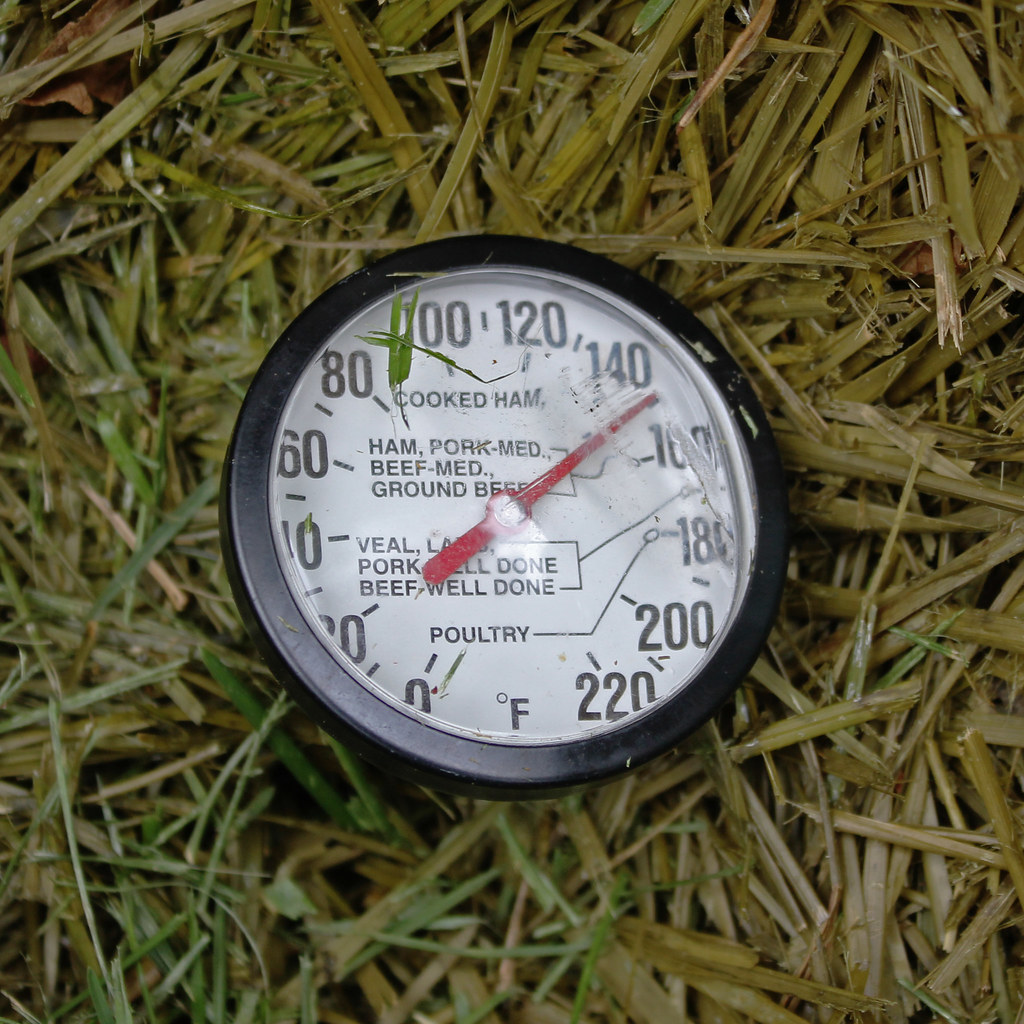
He has a small probe thermometer with a 12-inch stem that he pushes into the centre of the pile at every visit. The reading is recorded in the exercise book. The pile held at or above 130 degrees Fahrenheit for 88 of 112 winter days in the 2024-25 season.
The 2025-26 season, the one Wintergreen observed, ran shorter. The pile was built later (December 11th) and burned hotter early. By March 9th it had dropped below 100 and Owen judged it spent. He uncoupled the mesh cylinder, spread the finished compost on his garden, and let the greenhouse run unheated for the rest of the spring.
Total fuel for the season: 320 pounds of horse manure, 320 pounds of hay, roughly 30 gallons of added water, and three pitchfork sessions. Total heating cost: zero dollars in electricity and roughly $45 in transport for the manure.
The output, in addition to the heat, is approximately 300 pounds of finished compost in the spring. Owen spreads it on his asparagus bed. The asparagus, he says, has noticed.
There are limits to the method. The reactor will not heat a large greenhouse. Owen's 80-square-foot lean-to is, in his estimation, near the upper bound for a single cylinder. A 200-square-foot greenhouse would require two reactors or a much larger central pile.
The method also requires a reliable supply of fresh horse manure or similar high-nitrogen feedstock. In Hampshire County, with its dense network of small equestrian operations, this is not difficult. In a more urban setting it might be.
The third limit is smell. A compost reactor in a closed greenhouse smells, on most days, of warm hay and earth. On a damp January afternoon after a turning, Owen admits, it can smell distinctly of horse. The lemon tree does not appear to object.
What the method gives in return is a winter greenhouse that runs on its own metabolism, that produces no carbon emissions, and that hands the gardener a barrowload of compost in the spring as a kind of bonus. Owen intends to build a second reactor for the 2026-27 season. He is looking for the manure now.