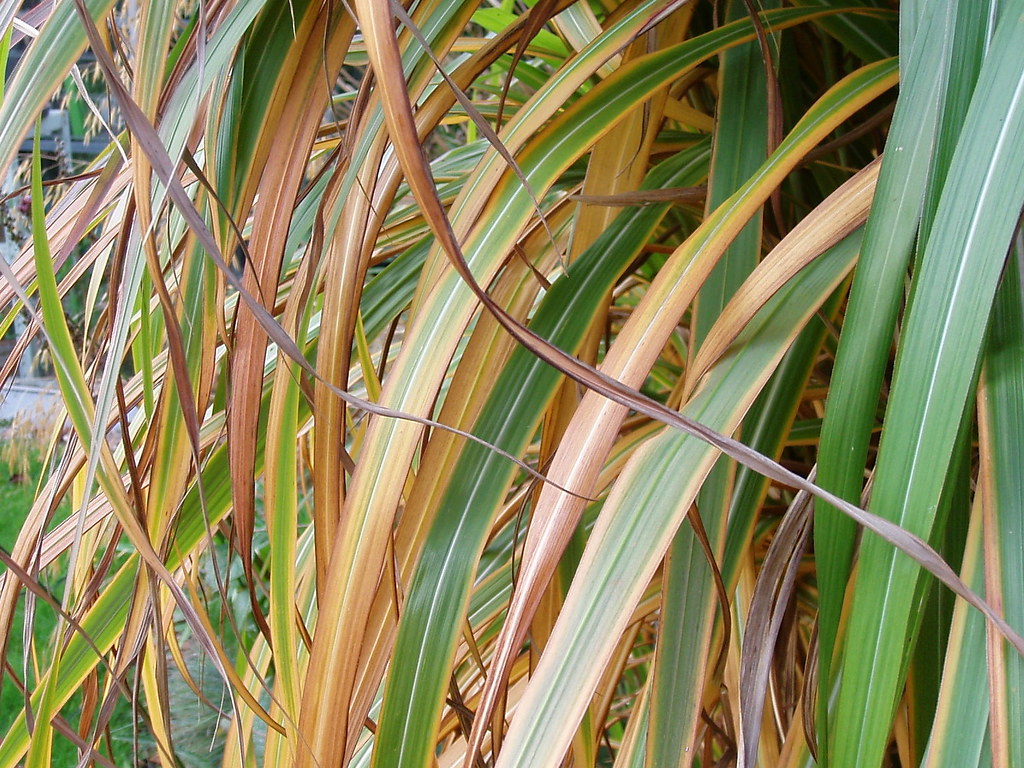
The border in question runs along the eastern side of a 1923 farmhouse in Mount Vernon, Iowa, ninety feet long and twelve feet deep, planted by Eleanor Whitlow over the past twelve years.
Whitlow is seventy-four. She is a retired botany professor from Coe College. She designed the border, she says, as a kind of belated argument with her own training, which had taught her to think of a garden as a sequence of flowering events rather than a continuous form.
The border has been planned, since 2017, for September through January. The summer months are deliberately quieter.
What this means in practice is a planting dominated by native and naturalised grasses, by late-flowering perennials, and by a deliberate decision not to cut down anything until the second week of March.
The structural backbone is provided by four species of grass.
Panicum virgatum Northwind, the upright switchgrass selected for its strict vertical form, occupies the back of the border in repeating clumps every eight feet. It reaches six feet by late August and turns burnished gold from October through January.
Schizachyrium scoparium, the native little bluestem, fills the middle layer in drifts. Whitlow grows the straight species and a selection called Standing Ovation for its more upright habit. Its foliage turns coppery in October and holds the colour through deep winter.
Sporobolus heterolepis, prairie dropseed, fronts much of the southern half. It flowers in August with a distinctive fragrance Whitlow describes as buttered popcorn. The plumes hold seed through November.
Pennisetum alopecuroides Hameln, the dwarf fountain grass, fills the gaps along the path edge. Whitlow notes that it is not native but has earned its place through reliability.
Among the grasses, she has planted late perennials chosen for the persistence of their seed structure.
Eryngium yuccifolium, the rattlesnake master, sends up dome-headed flowers in July that dry to a pale silver by September and persist through January. Three large clumps anchor the middle of the border.
Echinacea pallida and Echinacea paradoxa contribute black seed cones from August onward, which Whitlow leaves untouched. The American goldfinches strip them by November.
Liatris ligulistylis flowers in late August and holds its candle-shaped seedheads through the autumn. Whitlow planted twelve in 2018 and now has perhaps eighty through self-seeding.
Rudbeckia subtomentosa Henry Eilers, with its quilled yellow petals, blooms in September and holds black seed cones into December.
Solidago rugosa Fireworks, a well-behaved goldenrod, provides the last bright flowering in early October and dries to a rust-coloured haze that holds through winter.
The principle Whitlow returns to is restraint. She has deliberately excluded the showier autumn perennials, the chrysanthemums and the late dahlias, in favour of plants whose interest lies in form and persistence.
She has also rejected the spring-cleaning instinct that drives many gardeners to cut down their perennials in November. The border stands through ice, snow, and freezing rain.
On a January morning, after a sleet storm, the entire border is encased in clear ice. The grasses bow but do not break. The seedheads catch the light. Whitlow has photographs of this condition going back nine years, and she says it is the season the garden makes its argument most clearly.
The border attracts the kind of attention winter gardens rarely receive. Whitlow estimates she has counted, in the past five winters, twenty-seven species of bird feeding in the border between November and February.
The goldfinches strip the Echinacea. The juncos and tree sparrows feed beneath the grass clumps on fallen seed. A single Carolina wren has wintered in the dropseed for three consecutive years.
Whitlow cuts the entire border to the ground in mid-March, in a single day's work with a sharp hedging shear. The cuttings go to the compost heap behind the barn. By the second week of April the new growth is already pushing through.
Her advice to gardeners considering an autumn border is two-part. Choose grasses native to your region, not the showy Asian miscanthus that need staking by November. And learn to leave things alone.