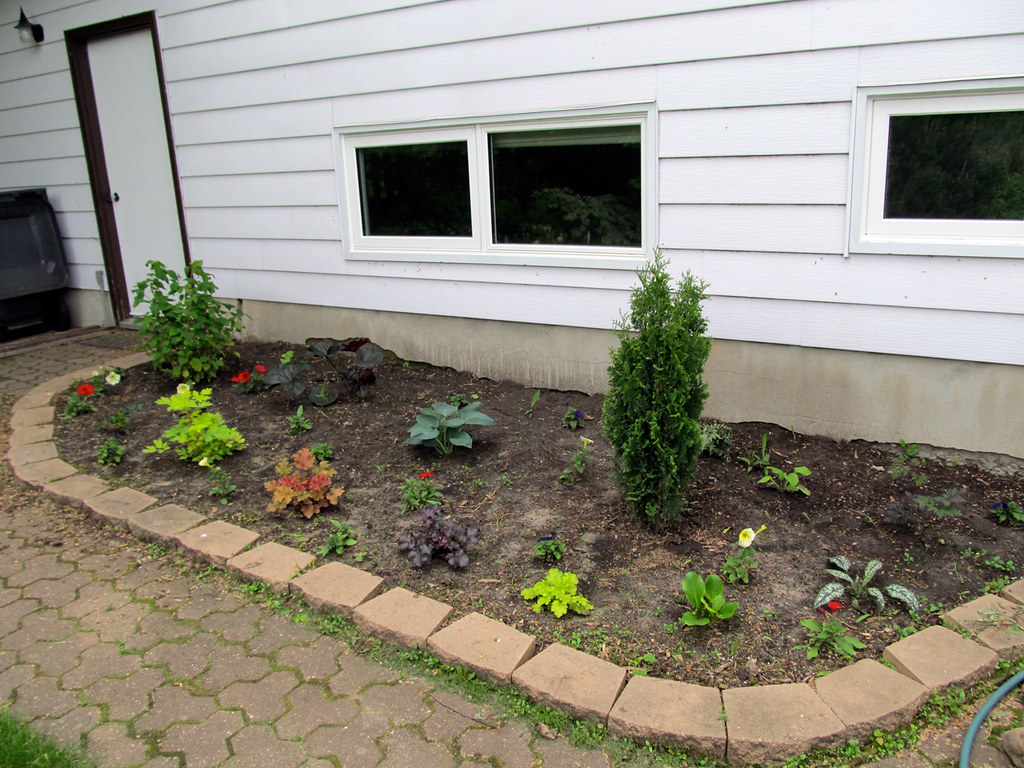
The cottage stands on the edge of Hebden Bridge, at the western end of a row of weavers' houses built in 1834. The garden behind it runs forty feet along the back of the house, north-facing, in dry shade cast by the cottage itself and by a high gritstone wall that holds the slope above.
The gardener is Margaret Stoker, who has worked the border for nineteen years. She inherited a strip of bare soil, a leggy laurel, and a Russian vine that she removed in her first winter.
What she has built is a shade border that holds interest for eight months of the year and survives without irrigation in soil that is, by her own measurement, frequently dust by August.
Dry shade is the hardest condition in temperate gardening. The roots of trees and walls take both moisture and nutrients. Most ornamental plants advertised for shade assume a moist woodland soil that gritstone Yorkshire does not provide.
Stoker began by feeding the soil rather than choosing plants. She has added two inches of leaf mould every autumn since 2007, sourced from the bag-leaf collection at Calderdale Council. She has never dug it in. She has spread it on the surface and let the worms do the work.
The result, eighteen years later, is a soil that holds moisture for perhaps four days longer than the unimproved equivalent. It is not lush. It is, she says, workable.
Her plant palette is narrow and intentional. She names twelve species that have proven themselves repeatedly. The rest, she says, came and went.
Epimedium x perralchicum Frohnleiten occupies the eastern third of the border in a continuous mat. It flowers in late April with small yellow blooms and holds its foliage through the year. It is, she says, the foundation.
Pulmonaria Diana Clare follows in early May. The flowers are intense violet-blue and the silvered foliage continues to perform after flowering, until July when she cuts it hard to the ground for a second flush.
Hellebores carry the late winter. She grows mostly Helleborus x hybridus seedlings of unknown parentage, raised from seed in 2011 from a friend's garden in Wensleydale. They begin to flower in late February in the cottage's microclimate and continue into April.
The summer is the difficult season for shade. Stoker turns to foliage and form.
Hakonechloa macra Aureola spills along the front of the border in mounds of arching gold-and-green leaves. It is the only ornamental grass she has found that thrives in deep dry shade. She has divided her original plant fourteen times since 2009.
Heuchera Plum Pudding and Caramel provide contrasting foliage in mid-border. She replaces individual plants every four years as they become woody.
Polystichum setiferum, the soft shield fern, anchors the back of the border. Three large clumps have grown from divisions of a single plant given to her by her neighbour Brenda Caulfield in 2008. They reach four feet across and hold their fronds through mild winters.
Late summer is carried by a single Japanese anemone, Honorine Jobert, which has spread to occupy perhaps eight square feet. Stoker considers it on the edge of misbehaviour but values its white flowers in September when little else is in bloom.
She has rejected hostas after sustained failure with slugs. Brunnera macrophylla Jack Frost failed for the same reason. She does not grow heucherellas, which she finds short-lived in her conditions.
Bulbs are her quiet secret. She has planted three hundred snowdrops, Galanthus nivalis, in successive autumns. They naturalise readily in the leaf mould and now flower in continuous drifts from late January to mid-March.
Cyclamen hederifolium fills the same role in autumn, flowering from August through October with marbled foliage that persists through winter. She has eight square feet of self-sown seedlings beneath the laurel that replaced the old one.
What Stoker has learned, she says, is that the shade gardener works by accumulation rather than display. The border was not impressive in 2010. It became impressive somewhere around 2018.
She does not photograph it. She walks it in the morning with her tea, and she writes nothing down.
Filed under