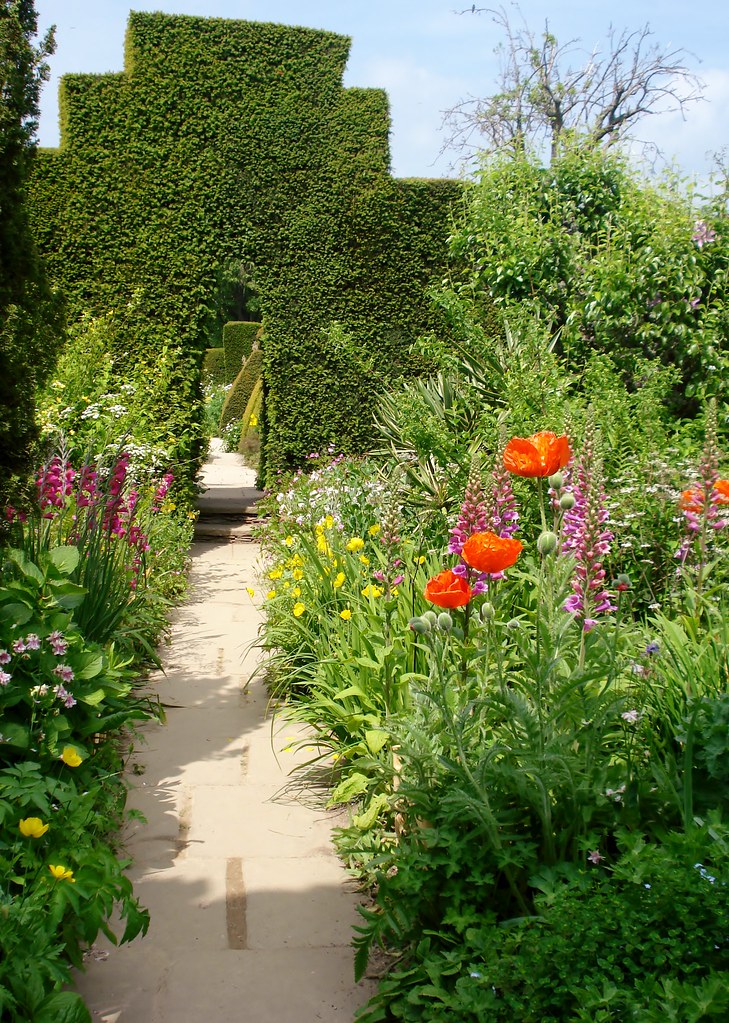
The Long Border at Great Dixter runs for two hundred and twenty feet along the south side of the meadow, between the porch yew and the topiary pheasants near the loggia. It was begun by Nathaniel Lloyd in 1912 and remade in successive generations by his son Christopher and now by the gardeners under Fergus Garrett's direction.
It is the most photographed perennial border in England. It is also a working garden, replanted in part every year, and the photographs do it less justice than a single afternoon of standing in front of it.
Rowena Bell visited four times in 2026, in late April, mid-June, early September, and the second week of November. What follows is what she saw.
On April 21 the border is still mostly bare soil and emerging foliage. The early tulips are in their second week. Spring Green, white with pale green stripes, occupies the front third of the southern half. Behind them the foliage of Euphorbia palustris is already two feet high, glaucous and arching.
A young gardener named Imogen Pike is staking peonies along the back of the border with hazel rods cut from the estate's coppice the previous February. She works without measuring, eyeing the height by hand.
The bones of the border are visible at this season in a way they will not be again until November. Bell counts the structural shrubs: two large dahlias still in pots beside the path, three young figs in training against the back wall, a clipped box at the central crossing, a Magnolia x loebneri at the eastern end coming into its last week of bloom.
April is a season of intention. The border has been weeded twice in the previous month and topdressed with the estate's own compost. The smell at the front is of warm earth and the first oriental poppies opening their hairy buds.
On June 17 the border has become itself.
Bell counts seventy-three species in flower along a thirty-foot stretch alone. The foreground holds catmint, hardy geraniums, lady's mantle in full chartreuse cloud, and a planting of Cerinthe major Purpurascens that has self-sown into the gaps.
The middle layer is dominated by oriental poppies in three colours, salvias Mainacht and Caradonna, and a tall pale lupin called Chandelier. The poppies are at their second-week peak and will be cut to the ground within ten days.
Garrett, walking past with a cup of tea, mentions that the Cerinthe was a Christopher Lloyd discovery from the early 1990s and has been allowed to wander ever since.
The back of the border in June is held up by the first delphiniums, by foxgloves of three colours, by emerging Joe Pye weed and the foliage of asters yet to flower. Behind them, the trained figs are at full leaf.
What June teaches a visiting gardener is the discipline of layering. The Long Border has perhaps fourteen distinct vertical zones, each occupied by a plant whose performance peaks at a different week.
September 8 is the season most gardeners come to Dixter to study.
The dahlias have moved from their pots into the gaps left by spent perennials. Bishop of Llandaff, Hillcrest Royal, and a pale apricot called David Howard dominate the middle layer. Behind them, Verbena bonariensis has reached six feet and is alive with bees.
The grasses, planted as deliberate textural counterweights, have come into their own. Stipa gigantea catches the afternoon light. Miscanthus Morning Light flowers at the back of the eastern half. Pennisetum villosum spills onto the path.
The asters open in waves through September. Aster x frikartii Mönch begins in late August and holds until October. The New England asters, planted at the back, come into flower in the second week of September and continue until first frost.
Bell notes a single particular pairing: a clump of Persicaria amplexicaulis Firetail grown next to a stand of Helianthus Lemon Queen. The red spires and yellow daisies should clash. They do not. They sing.
By November 11 the border has gone through the long retreat that English gardeners learn to read.
Frosts have come in three waves, the first on October 14, the heaviest on October 28. The dahlias have been lifted and stored. The cosmos are gone. What remains is the architecture of seedheads, grasses, and the last asters.
Bell counts forms rather than flowers. Sedum Matrona still holds its umbels, now bronzed. Eryngium leaves a constellation of silver thistle-heads. The Verbena bonariensis stands skeletal but upright. The grasses, especially the Miscanthus, hold their plumes silver against the low sun.
Garrett tells her, when she meets him in the lower nursery, that the November border is the one most working gardeners come to see. It teaches the lesson the photographs do not, which is that the border has a fourth season.
What Bell takes away from four visits is not a list of plants. It is the rhythm of replacement. Great Dixter is not a garden of permanence. It is a garden of succession, in which a perennial border is understood as a living calendar.