Rowena Bell buys her straw from a farmer named Geoff Edworthy who keeps a small herd of Devon Red cattle at Combeinteignhead. He bales his own wheat straw in August, stores it in a stone barn behind the farmhouse, and sells it to a handful of local gardeners through the autumn and winter at a price that has not changed since 2019.
Bell takes ten bales each year. They cost her, in 2026, fifty-eight pounds for the lot, including delivery.
Ten bales is enough to mulch every bed in her kitchen garden twice over the course of a year, with a little left over for the rhubarb patch and the asparagus bed at the side of the lawn.
Bell has, in twenty-eight years of gardening, tried most of the available mulches. Bark chip, which she found too coarse for vegetable beds and too slow to break down. Cocoa shell, which the dog ate. Black polythene, which the slugs adored. Grass clippings, which matted and went anaerobic. Wood chip, which tied up nitrogen for a season. Living mulches of clover, which competed with the crop. Leaf mold, which she made and used but never had enough of.
She has come back, year after year, to straw.
What straw does well is unspectacular. It covers the soil. It holds in moisture. It moderates surface temperature. It suppresses most annual weed seeds. It breaks down slowly enough to last a season and quickly enough to disappear into the soil within a year of being turned in.
What it does not do is what most novel mulches promise. It does not feed the soil with rich organic matter. It does not bring beneficial fungi. It does not photograph well on a sunny morning.
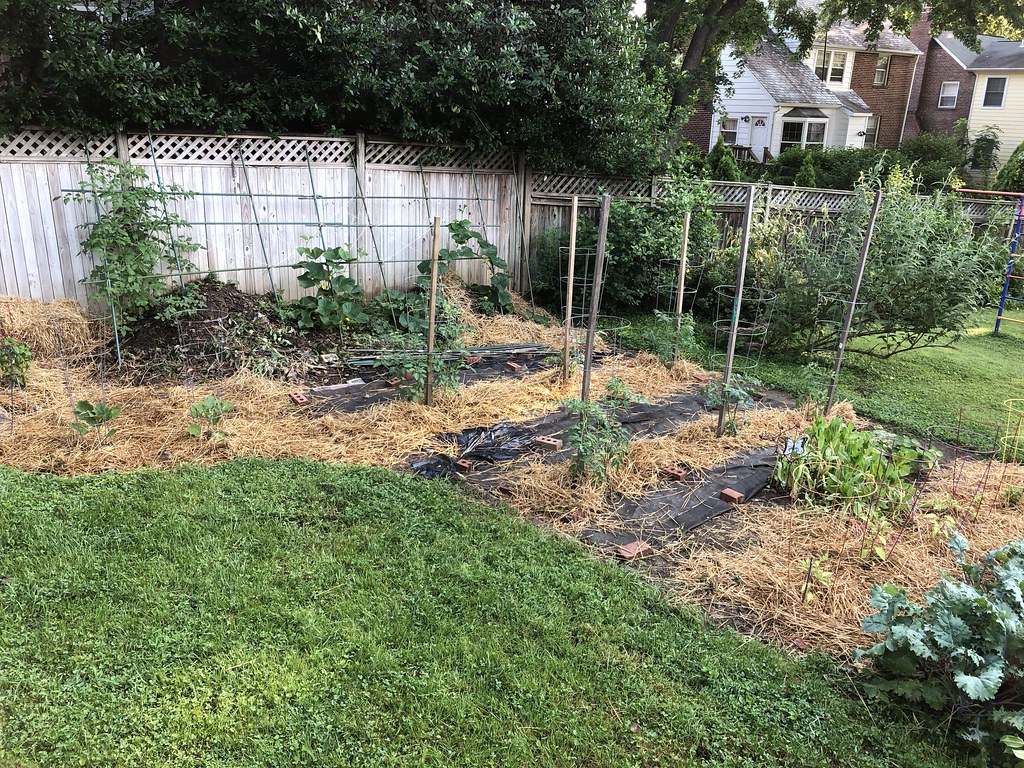
Bell mulches twice a year. In late April, after the soil has warmed, she lays a one-inch layer of loose straw around her transplants and across the surface of the bare beds. In November, after the last of the autumn crops are out, she lays a two-inch layer across the whole garden to carry the soil through the winter.
She does not chop the straw before laying it. She did, for a few seasons in the late 2010s, run it through a shredder. The shredded straw broke down faster but blew around in the spring winds and gave the same protection as the unchopped material for more work.
The straw she buys is not perfectly clean. There is wheat seed in it, and the seed germinates in spring as small bright-green spears. She pulls them by hand or hoes them off in May, and by June they are gone. This is the principal objection a gardener might raise to straw mulch, and it is a reasonable one. A gardener who is not willing to spend an hour pulling volunteer wheat in May should buy a more expensive, certified seed-free straw, or use a different mulch altogether.
Bell is willing to spend the hour. The wheat comes out easily from the soft, mulched soil, and the work is not unpleasant.
The economics of straw are, for a garden of her size, hard to beat. Fifty-eight pounds a year is less than she spends on tomato starts in any given spring. Bark chip for the same area would run her two hundred. Bagged compost for use as a mulch would be more than that.
The soil benefit, while modest, accumulates. Each bale of straw she turns into a bed at the end of a season adds roughly twenty pounds of dry organic matter to the soil. Over a decade, that comes to several hundred pounds per bed of slow-cycling carbon.
She does not run a soil test specifically to track the effect of the straw. Her three-yearly tests, which Octavia Bryne writes about in this issue, have shown a slow rise in organic matter from 4.1 percent in 2015 to 5.6 percent in 2024. The straw is part of that, along with the compost, the leaf mold, and the cover crops.
The case for straw is, as Bell makes it, a quiet case. It is the cheapest serviceable mulch she has found. It does the basic work of a mulch reliably. It does not require enthusiasm, and it does not invite extravagant claims.
She will keep ordering ten bales a year from Geoff Edworthy for as long as he keeps baling.
He is sixty-eight this autumn, and he has told her, vaguely, that he is thinking about not putting in wheat in 2028. Bell has not asked him what he plans to do instead. There is time enough to find another supplier when the question becomes urgent.
For now there are ten bales in the barn, and the late-spring mulch is already going down.