Sage Marchetti's small greenhouse in Northampton, Massachusetts, holds 142 seed flats in early April, which is the moment in the year when watering becomes a daily decision rather than a casual one. In 2026, between the seventh of April and the twelfth of June, she carried three watering cans through her seed-raising season and kept a log of which one she reached for and why.
The cans were a Haws long-reach two-gallon in galvanised steel, made in Smethwick and bought in 2018; a one-gallon Bosmere copper can given to her by her sister at Christmas 2023; and a French plastic can in a pale grey, marketed as a Sèvres-style reproduction, bought at a hardware store in Amherst in March 2026 for $14.50.
The Haws is the canonical English watering can, designed in 1886 by John Haws as an improvement on the short-spout cans then in use. The long reach permits the can to be tipped into a greenhouse staging without the user climbing onto a stool. The brass rose at the end of the spout produces, when tipped at the proper angle, a fine even shower that does not disturb seedlings.
The Bosmere copper, much heavier when full, has the same long-reach design but in a softer metal that develops a patina over time. The rose on this can is also brass, but the fitting is slightly looser than the Haws, which Marchetti has come to think is a manufacturing tolerance rather than a design choice.
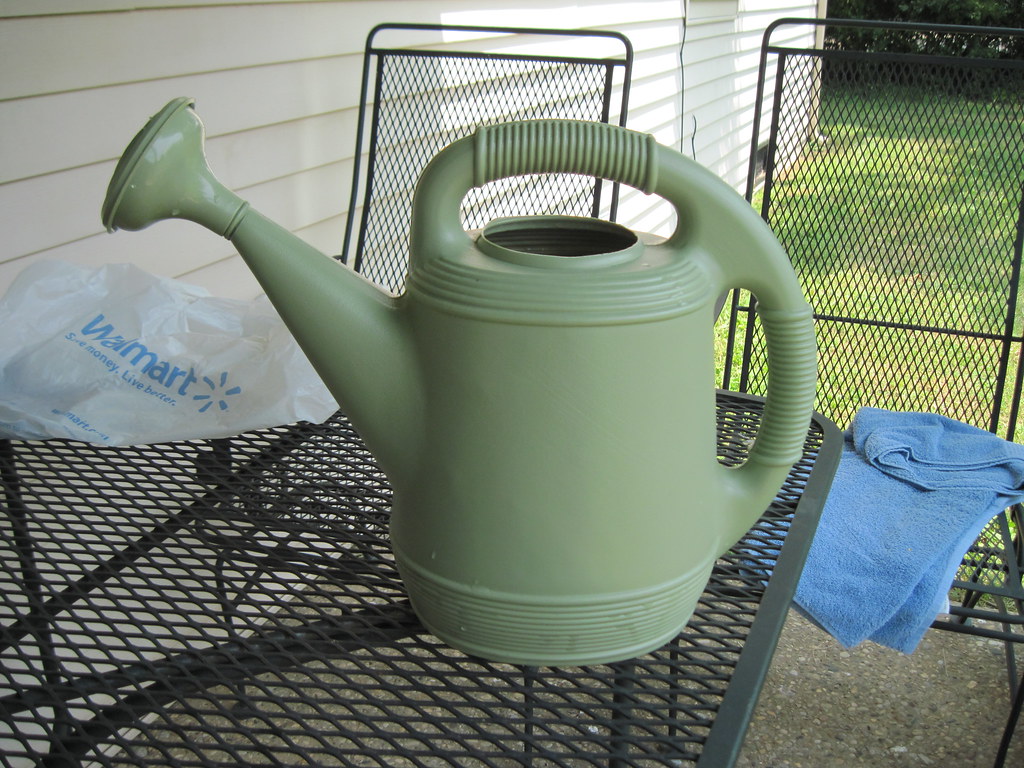
The plastic can is lighter than either, holds less, and has a moulded rose that is not removable. It is not, in any honest sense, in the same class as the other two. Marchetti included it because she wanted to know whether a $14.50 plastic can could do the work, and because she has seen many gardeners assume that the cheap can is the right choice for seedlings because the water comes out softer.
The first week of the trial was given to germinating brassicas: kale, broccoli, kohlrabi, and a small flat of mustard greens for the spring salad mix. Marchetti watered each flat on alternate days with a different can, taking care to apply approximately the same volume of water and to tip each can at approximately the same angle.
The Haws produced, as expected, the finest spray. The droplets are small and uniform, distributed across the rose's 180 perforations in a pattern that has been refined by Haws over four decades of incremental design. The brassicas raised under the Haws germinated evenly and showed no surface disturbance.
The Bosmere copper produced a slightly heavier spray, with larger droplets and a less uniform distribution. The brassicas raised under it also germinated evenly, but Marchetti noticed a small scattering of seeds that had been moved out of position by the heavier droplets in the first watering.
The plastic can produced a spray that was, in technical terms, more like a sprinkling. Some of the perforations on the moulded rose were partly closed by injection-moulding flash that Marchetti could feel with her thumbnail. She cleared them with a sewing needle before the second use, which improved the pattern but did not bring it close to the Haws.
By the third week the differences had become both more obvious and less important than she had expected. All three cans grew brassica seedlings successfully. The Haws produced the most aesthetically satisfying watering experience; the Bosmere produced almost the same result with slightly more attention to angle; the plastic produced a workmanlike outcome that no objective measurement would have rejected.
What changed her ranking, in the end, was not the spray pattern but the weight and the balance of the cans when full.
The Haws two-gallon weighs 8.2 kilograms when full of water. The Bosmere copper, also full, weighs 7.6 kilograms, although its body holds a quarter less because of the heavier metal. The plastic, full, weighs 4.1 kilograms.
Across an afternoon of watering 142 flats, with each flat receiving roughly half a litre of water in three passes, the gardener lifts somewhere in the region of 60 to 80 kilograms of water from the tap to the flats. The choice of can is, among other things, a choice about how much of that weight ends up loaded onto the user's wrist, elbow, and lower back.
Marchetti is fifty-one. She has a small persistent ache in her left wrist that began in 2021 and that she has learned to manage by attention to the tools she lifts. The plastic can, despite being aesthetically and technically inferior, became her default for the long sessions in late April and May because it produced less ache.
The Haws remained her choice for the early-morning watering of the most delicate flats, where the fineness of the spray mattered more than the weight on her wrist. She used it for perhaps a third of the daily watering through the season.
The Bosmere copper she used least, but kept on its hook because she liked looking at it and because her sister had given it to her. This is, she would say, a defensible reason for keeping a tool.
The trial taught her something she did not expect, which is that the right watering can is not a single object but a set of objects suited to a set of tasks. The Haws is the right can for the conservatory bench and the seedling tray. The plastic can is the right can for the working watering of a full greenhouse on a Tuesday afternoon. The copper can is the right can for the kitchen window, where its weight is irrelevant and its look pleases the user every time she walks past it.
There is a small body of literature on watering cans as design objects, most of it in the niche of horticultural history. The Haws long-reach has been included in design exhibitions at the Victoria & Albert Museum and at MoMA. It is one of perhaps a dozen garden objects that have been so honoured.
The honour is, Marchetti thinks, somewhat misplaced. The Haws is a fine working tool. It is also, in 2026, expensive: the two-gallon she bought in 2018 for $89 now retails for $148. The brass rose alone, sold as a replacement part, costs $42. A new gardener entering the hobby and reading enthusiastic prose about the Haws can be forgiven for thinking that the design itself, rather than the work it permits, is what is being celebrated.
She does not believe this. She believes that the work matters, that the tools are in service to the work, and that the gardener who can afford a Haws is fortunate but not, by virtue of the purchase, a better gardener.
On the twelfth of June 2026, the morning the last of the tomato seedlings were potted on into their final containers, Marchetti carried the plastic can to the tap for the last time, filled it, and watered the long bench of newly potted tomatoes. The plastic can, she has decided, will go to a community-garden in Holyoke that has been asking for donations of working tools.
The Haws will hang on its hook in the greenhouse, ready for next March. The copper can will go back to the kitchen window.
Filed under