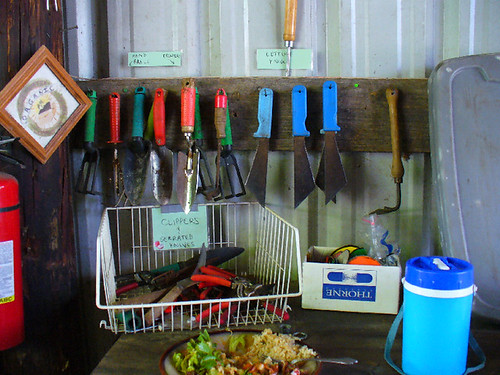
In a wooden rack against the south wall of Eloise Vinter's tool shed in Norwich, eleven hand tools hang in a row. Nine of them have wooden handles. The two that do not are a Japanese trowel with a steel handle, kept for a particular kind of fine transplanting work, and a fibreglass-handled pickaxe she inherited from a neighbour who moved to a flat in 2019.
The wooden handles are mostly ash. Three are hickory. One, the handle of her favourite hand fork, is beech that has darkened to nearly the colour of dark honey. None of them was new when she acquired it. All have been re-shafted, oiled, sanded, or otherwise tended to in the course of being used.
She did not set out to become a person who chose wooden handles. She inherited some of the tools, bought others without thinking about the handle at all, and replaced a few synthetic handles over the years because they broke or because she came to dislike them in the hand.
The case against wood, in the catalogues at least, is straightforward. Wood is heavier than fibreglass. Wood absorbs water and swells. Wood splinters. Wood eventually rots. Wood is more expensive to manufacture than injection-moulded composite. None of these claims is wrong. None of them, in Vinter's experience, has turned out to matter very much.
The case for wood is harder to articulate without sounding like a person trying to sell something. It comes down to three properties: warmth, damping, and repairability.
Warmth is the property of a material that does not pull heat from the hand. A wooden handle in February is not warm in any thermodynamic sense; it is simply less cold than a steel or fibreglass handle of the same surface temperature. The hand picks it up without flinching. Over a long winter morning of pruning this matters more than the specification sheets suggest.
Damping is the property of absorbing vibration without transmitting it into the bones of the hand. A wooden handle absorbs more of the shock of a spade striking a buried brick than fibreglass does, and considerably more than steel. After a long day of digging in stony soil the gardener with a wooden-handled spade feels less battered than the gardener with a fibreglass one. This is not an opinion; it has been measured.
Repairability is the property of being fixable by an ordinary person with ordinary tools. A wooden handle that cracks can be replaced in a quiet hour at the bench, with a hand brace, a chisel, and a new shaft from a tool supplier. A fibreglass handle that cracks is, in practice, the end of the tool's working life. The head can be salvaged. The tool, as a coherent object, cannot.
Vinter has re-shafted seven tools in the last eight years. The work is slow and pleasant. It requires no skill she did not have before she began. The first re-shafting she did, of a digging fork in 2018, took her most of a Saturday afternoon. The most recent, of a small hand cultivator last November, took thirty-five minutes.
The trick, she has come to believe, is to choose the right wood for the right tool. Ash is the standard for spades, forks, and rakes. It is springy, light, and resistant to splitting along the grain. Hickory is the standard for axes and mattocks. It is denser than ash, less springy, and better at absorbing the shock of an impact. Beech is the standard for short-handled hand tools, where the weight is in the user's hand rather than swung at the end of a long lever.
Maple, birch, and oak are also used. Oak, in particular, is favoured for old English digging spades, where its density gives a certain authoritative weight to the swing. Vinter does not own an oak-handled spade. She has used one, at a friend's garden in Suffolk, and found it pleasant but heavier than she wanted for a long day.
The maintenance of a wooden handle is simple. Once a year, in February, Vinter takes each handle off its hook, sands it lightly with 240-grit paper to remove any raised grain, and rubs it with raw linseed oil. The oil is applied with a soft cloth, left for twenty minutes, and the surplus wiped away. The handle is hung back on the hook and forgotten for a year.
She does not use boiled linseed, which contains driers. She does not use Danish oil, which contains varnishes. She does not use mineral oil, which never dries. She uses raw linseed from a small mill in Lincolnshire that she discovered through a wood-turner in Wymondham.
The oiling takes about twenty minutes per tool. Across eleven tools it takes a quiet morning. She does it on the first Saturday of February, with the radio on, and counts it as the official beginning of the gardening year.
There is a question, which she has been asked more than once, about whether wood is a more sustainable choice than synthetic. The answer is more complicated than the questioner usually wants. A well-managed ash plantation, growing on land that would not otherwise be forested, sequesters carbon for the life of the tree and stores it for the life of the handle. A fibreglass handle is made from petroleum-derived resin and glass fibre, neither of which is renewable on any human timescale.
But ash, in 2026, is itself in trouble. Hymenoscyphus fraxineus, the fungus responsible for ash dieback, has killed perhaps eighty percent of mature ash in Britain since the disease was first identified in 2012. The supply of ash for tool handles is not yet limited, because the felled trees are being processed faster than they can be milled, but in twenty years it may be. Hickory in North America is under similar pressure from a complex of pests and pathogens.
Vinter does not have a clean answer to the sustainability question. She has chosen to use what is available now, to maintain it carefully, and to keep the resulting tools in service for as long as she can. A handle that lasts thirty years is, by almost any measure, a more sustainable choice than a handle that lasts five.
The eleven tools in her shed are not a collection. They are the working set of a person who has gardened for nearly thirty years and has, by trial and replacement, arrived at a stable equipment list. The handles will, with care, outlast her own working years. After her time the tools will go to a niece in Bristol who has begun to garden and who will, perhaps, oil them every February with raw linseed from the same mill in Lincolnshire.
If they do not, the handles will rot in someone else's shed, and the steel heads will rust, and the whole assembly will go back into the soil of some other garden. This is, on balance, what wooden handles are for.
Filed under