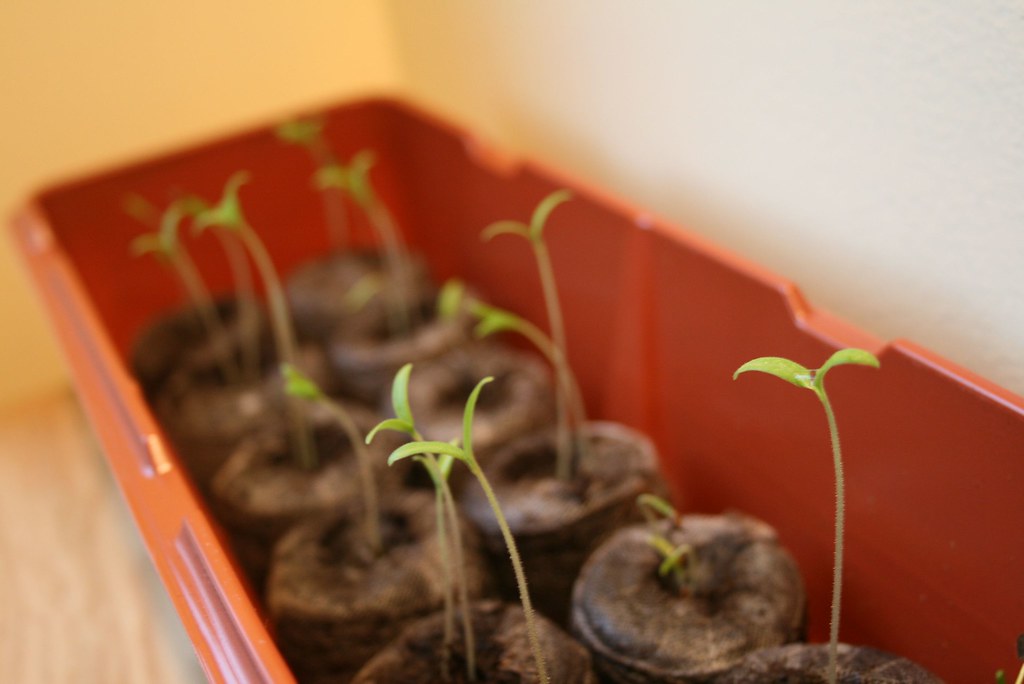
In her propagator in Devon, on the morning of March 18, 2026, Rowena Bell looked at a tray of seventy-two Brussels sprout seedlings and counted twelve she would discard.
The cotyledons, the seed leaves, had been uniform across the tray a week earlier. Two round paddles, mid-green, indistinguishable. By the morning of the eighteenth, the first true leaves were emerging at the centre of each plant, and the tray was no longer uniform at all.
The first true leaves are the gardener's first honest look at the seedling. The cotyledons are stored food. The true leaves are the plant's own work, the first photosynthetic structures it builds from scratch, and they reveal whatever the parent seed has carried in.
On a Brussels sprout the first true leaf should be small, blue-green, slightly cupped, with a faintly serrated margin. Bell has been growing the same Evesham line since 2012. She knows what the leaf should look like at the moment of emergence.
Of the seventy-two plants, fifty-eight matched. Twelve did not. Two had leaves that emerged distinctly paler than their cotyledons, a sign of either nutrient deficiency in the seed itself or, more often, of a slightly off-type cross from the previous year. Three showed leaf margins that were smooth instead of serrated, which in this line suggests an unwanted cross with a neighbouring cabbage.
Six had emerged with leaves twisted or fused along the midrib, a developmental fault that rarely corrects itself. One had a leaf that was glossy rather than dusted with bloom, which Bell associates with a kohlrabi cross from two years back that she thought she had selected out.
She pulled the twelve. The remaining sixty went on to pot up.
This is not pedantic work. The first true leaf is a window onto the genetics of the seed and the conditions of its germination, and pulling at this stage costs almost nothing. Pulling at the four-leaf stage, after three weeks of light and water, costs considerably more.
Different families show different diagnostic patterns. Solanaceae, the tomato and pepper family, show first true leaves that are unmistakably the adult leaf shape in miniature. A tomato true leaf is already pinnate. A pepper true leaf is already lanceolate. A misshapen first true leaf in a solanum is almost always a developmental defect, not a cross, and the seedling will usually recover.
Cucurbits are different. A squash or cucumber first true leaf is round to begin with and only develops its species-specific lobing after the second or third true leaf. The diagnostic moment in cucurbits comes later.
Brassicas, in Bell's view, are the most informative family at the first-true-leaf stage. The leaf shape, colour, bloom, and margin are all set. A grower who knows their line can spot an off-type within ten days of sowing.
Alliums are another matter altogether. Onions and leeks emerge as a single grass-like blade, which is the first true leaf, the cotyledon having stayed underground. Diagnostic information from an allium seedling is almost zero until the third or fourth leaf.
Bell keeps a small notebook beside the propagator. Each tray gets a half-page entry: variety, sowing date, germination percentage at seven days, first-true-leaf inspection date, discards and reasons. The notebook now has eleven years of entries.
She has learned, from the notebook, that her Evesham Brussels sprout line drifts toward smoother leaf margins at a rate of about two percent per year unless she selects against it at the seedling stage. Two percent per year is not noticeable in a single season. Over a decade it is a different vegetable.
Discarding at the seedling stage is sometimes called rogueing, an old word for the practice. Commercial seed houses do it on a larger scale. The home seed saver who skips it will lose their line within a decade.
Not every imperfect seedling should be pulled. A first true leaf that is small but otherwise correctly shaped usually indicates slow but normal development. Cold roots, recent transplant shock, low light. Those plants catch up.
A first true leaf that is correctly shaped but pale almost always indicates a problem at the seed end. The seed parent may have been deficient in nitrogen at fruit set, or the seed may have been stored too long. Those plants sometimes catch up, but they remain weaker, and Bell pulls them if she has spares.
The cotyledons themselves are worth a second look at this stage. A cotyledon that has yellowed at the tip by the time the first true leaf emerges is normal. A cotyledon that has shrivelled entirely while the true leaf is still small is a sign of poor early root development, often from overwatering.
Bell waters from below at this stage, by setting the trays in a shallow tray of water for ten minutes once every three days. Top-watering at the first-true-leaf stage knocks seedlings flat and packs the surface of the medium, which the small plants cannot push through.
She uses a peat-reduced sowing compost mixed one-to-one with sieved leaf mold from her own pile. The leaf mold provides slow nitrogen for the first three weeks, which is roughly the period between first true leaf and the first pot-up.
By April 8 the surviving sixty Brussels sprouts had four true leaves each and were ready for individual three-inch pots. She lost two more in potting up, both showing root coil from being left a week longer than ideal in the cell tray. Fifty-eight made it to the garden in mid-May.
The garden bed at the back of her plot is fifteen feet by four. It will hold thirty-six Brussels sprouts at standard spacing. The remaining twenty-two will go to a neighbour in Topsham who lost his own seedlings to a late slug raid, and to the school garden in Newton Abbot where Bell volunteers on Tuesdays. The discarded twelve, in late March, became compost. Which, in time, will grow other seedlings.
Filed under