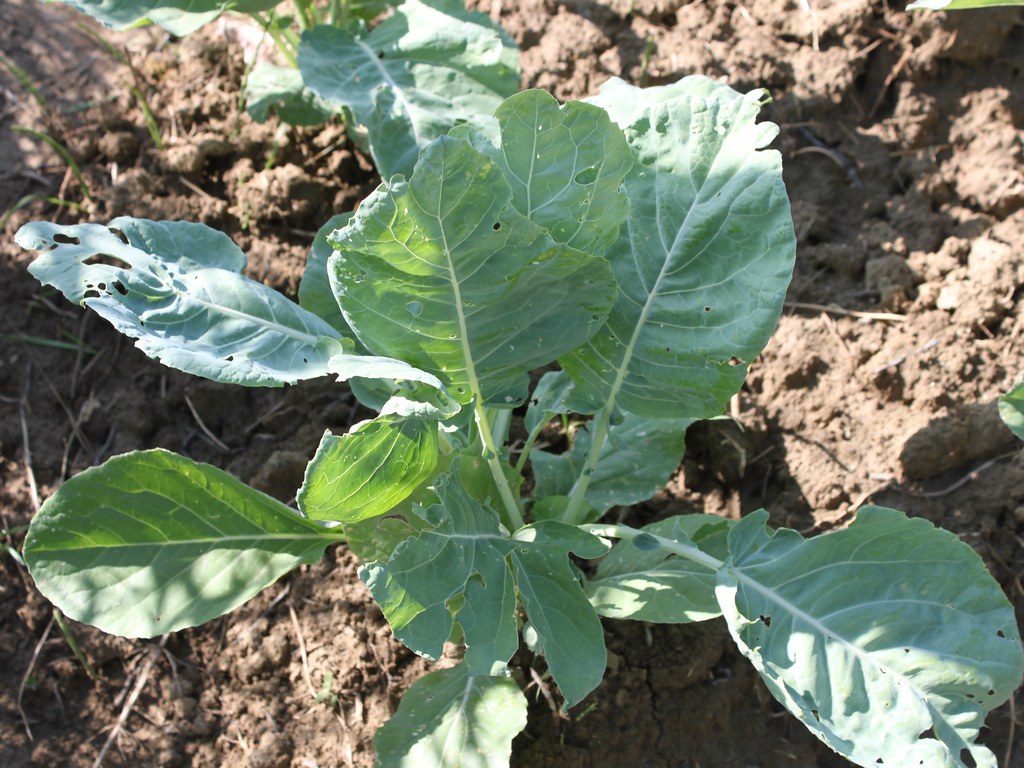
In the wet spring of 2024, on a small market garden near Hokitika on the West Coast of the South Island, the brassicas began to wilt for no apparent reason. Octavia Bryne was called in by the grower, an old colleague, in the second week of October.
The plants were six weeks past transplant. The cabbages, fifteen rows of them, were yellowing from the outer leaves inward. Three plants had collapsed entirely. When Bryne lifted one out of the soil the root system came apart in her hand: white tunnels, the size of a sewing needle, riddled what was left of the taproot, and several small white maggots fell out into the wet earth.
This is the cabbage root fly, Delia radicum, and the diagnosis was immediate.
The adult fly is small, grey, and superficially resembles a housefly. It lays its eggs in the soil at the base of brassica transplants. The eggs hatch within a week, and the larvae tunnel into the root, where they feed for about three weeks before pupating in the soil. The first generation in spring is the most damaging, because it attacks plants that are not yet established enough to compensate for the root loss.
The grower had lost about a third of her cabbage crop already. Another third was visibly stressed and unlikely to head up properly. The remaining third looked, in the wet light of that morning, salvageable.
Bryne's recommendation was simple and old.
Cabbage root fly collars are small discs of felt, plastic, or stiff cardboard, about ten centimetres across, with a slit cut from the edge to the centre. They are slid around the base of each brassica transplant at planting and lie flat on the soil surface. The fly cannot lay eggs through the disc, and the larvae cannot reach the root.
The technique was first described in the British gardening literature in the 1920s. It has been tested repeatedly since. It is, in any climate where the cabbage root fly is a serious problem, the single most effective non-chemical intervention available, with reported reductions in damage of seventy to ninety percent.
It costs, in materials, about ten cents per plant.
The grower had not been using collars. She had been growing brassicas successfully on the same land for eleven years and had never seen significant root fly damage before. The wet spring had produced fly populations larger than she had encountered in any previous season, and her routine practice was suddenly inadequate.
This is the part of pest management that the textbooks understate. A practice that has worked for a decade can stop working in a single anomalous year, and the gardener must be willing to add a new step to a previously settled system without resentment.
Bryne and the grower spent the afternoon cutting collars from a roll of roofing felt left over from a shed repair. They cut about three hundred discs, ten centimetres across, with a kitchen knife and a metal template. The work was tedious. By four in the afternoon they had enough collars for the entire autumn brassica planting that was already in the propagation tunnel.
The autumn brassicas — about two hundred and forty plants of cabbage, broccoli, and kohlrabi — were transplanted with collars over the following ten days. The grower also retrofitted collars around the bases of the surviving spring cabbages, which is a smaller intervention but worth attempting, because it at least prevents the second generation of flies from re-infesting the same plants.
The autumn brassicas, when Bryne visited again at the end of February, were uniformly healthy. The grower had inspected the roots of a sample of six plants at random and found no larval damage on any of them. The yield from the autumn planting, she said, was the best she had had in three years.
The spring 2025 planting went in with collars from the start. The spring 2026 planting also. The grower has no immediate plan to discontinue the practice, which she now considers a routine ten-cent cost per plant, completely justified by the avoided loss of a year like 2024.
There is no other moral to draw from this. A wet spring produced an unusual fly pressure. A small piece of felt around the base of each plant ended the problem entirely. The intervention was known to work in 1925 and is still known to work in 2026. Most of what is most useful in pest management is also the least novel.
The grower's market stall in the Hokitika Sunday market is, as Bryne writes this in late autumn, well-stocked with autumn brassicas. The cabbages are tight, heavy, and unblemished. None of the customers who buy them will ever know what the small felt circle at the base of each plant was for.