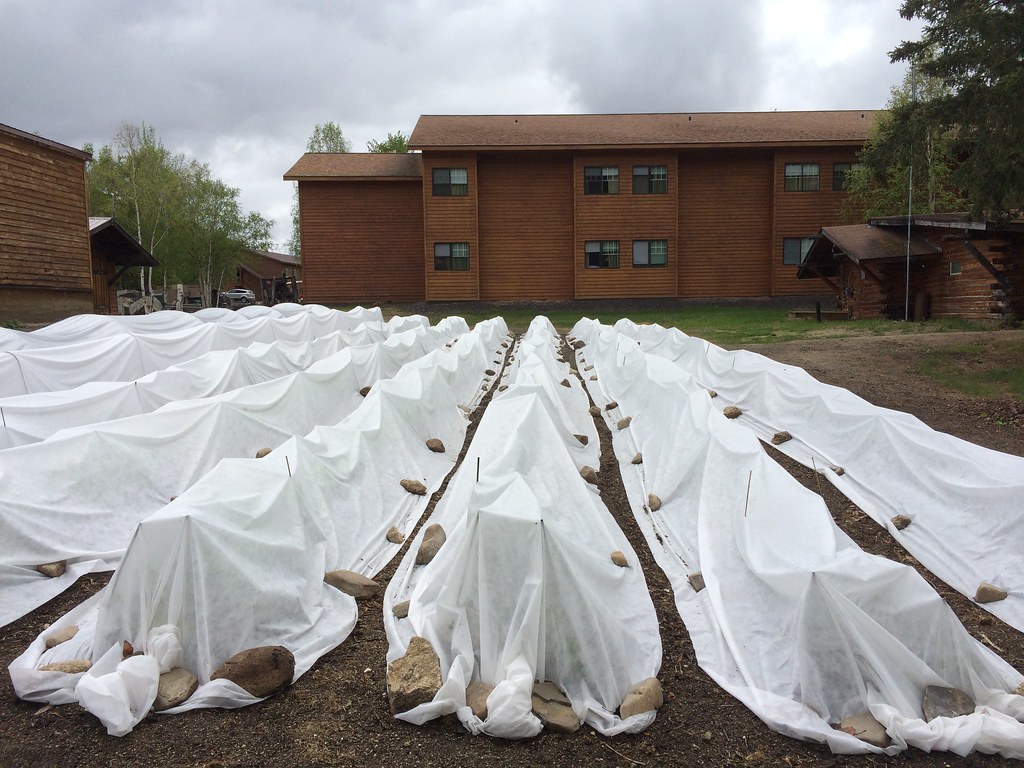
By the first week of May the cabbage white butterflies are flying in central Vermont. Sage Marchetti has been watching for them on her short walk to the seed library each morning, and on the morning of May 6th she counted four over the small park beside the Connecticut River.
That afternoon she put the covers on.
Marchetti's kitchen garden is a 25-by-40 plot behind a converted carriage house in Northampton, Massachusetts, where she keeps the Hampshire Seed Library. The brassica bed at the south end is twelve feet by four, raised six inches above the path, planted out the previous Saturday with sixteen broccoli starts and twenty-four heads of red cabbage from her own saved seed.
The floating row cover is a roll of Agribon AG-19, the lightest weight she stocks. It transmits about eighty-five percent of available light, breathes well, and weighs slightly under half an ounce per square yard. It does almost nothing thermally. What it does is keep the cabbage white butterflies, the cabbage looper moths, and the flea beetles physically off the leaves.
The physics is unromantic but the result is decisive.
She covers the bed in a single piece, six feet wide by fifteen feet long, with about two feet of slack across the top to allow for plant growth. The edges go down with three-inch metal landscape staples every eighteen inches along both long sides, and short pieces of 2x2 lumber laid across the short ends. Anything heavy enough to stop the cover lifting in a thunderstorm will do.
The cover stays on for four weeks.
This is the part that requires discipline. The brassicas under the cover will look, at the end of the first week, healthier than the uncovered ones. By the second week, noticeably so. By the third week, the gardener will begin to wonder whether the cover is needed at all, because there is no visible damage anywhere in the bed, and the temptation to pull it off and admire the plants without obstruction is real.
Marchetti has pulled covers off in week three twice in the last decade. Both times she lost the entire crop.
The cabbage white butterfly does not lay eggs on plants she cannot reach. She lays eggs, in considerable numbers, on plants she can reach the moment she can reach them. A four-week head start, for the plants, means that by the time the cover comes off at the end of the first week of June the leaves are tough enough that the first generation of caterpillars does manageable rather than fatal damage. A two-week head start does not.
The flea beetles, on the brassicas at this scale, are mostly a cosmetic problem. The cabbage moths are the actual threat. A small broccoli plant that loses eighty percent of its leaf area in the first three weeks after transplant does not recover, and the cabbage looper is capable of removing that leaf area in about six days.
The cover prevents this.
On the morning of June 4th Marchetti pulled the staples and the lumber, folded the Agribon into its storage bag, and walked the bed. The broccoli plants were eight to ten inches across, dark green, with no visible insect damage anywhere. The cabbage heads were beginning to close at the centre. She noted both observations in her ledger, with the date of cover-on and cover-off, the number of starts that had survived, and the temperature range across the four weeks.
The cabbage whites were on the bed within an hour. She watched one lay a cluster of pale yellow eggs on the underside of a broccoli leaf at about three in the afternoon and did not intervene.
This is the second piece of the row-cover argument. The covers are not for the whole season. They are for the four weeks that decide the season. By June the plants can take a level of damage that would have killed them in May, and by July the predator population in the garden is large enough to keep the caterpillar numbers below the threshold of visible harm.
Marchetti hand-picks caterpillars from the brassicas through July and August. It takes about ten minutes, three times a week. The harvest in October is reliable.
The seed library, at one point this past winter, ran a small workshop on row-cover use, and Marchetti made one slide for it that she keeps on her phone. It shows two photos of brassica beds, both taken on June 4th, both planted on April 30th. One was covered. One was not. The covered bed shows sixteen vigorous plants. The uncovered bed shows the chewed remains of nine. The workshop attendees mostly bought a roll of Agribon on the way out.
The roll is not expensive. Marchetti's roll, in its sixth season, is showing some wear at the staple holes but is otherwise sound. A single roll will cover a small kitchen garden's brassica bed for about eight years if it is folded carefully after each use and stored out of direct sun.
The covers go back on in late September for the fall brassicas, against a smaller late-season pressure of cabbage moths and the first frosts. The same roll, the same staples, the same four-to-five-week window.
The boring, repeated, calendar-driven act of putting a piece of fabric on a bed in early May is the single most consequential pest-management decision Marchetti makes in her gardening year. Nothing she does in July matters as much.