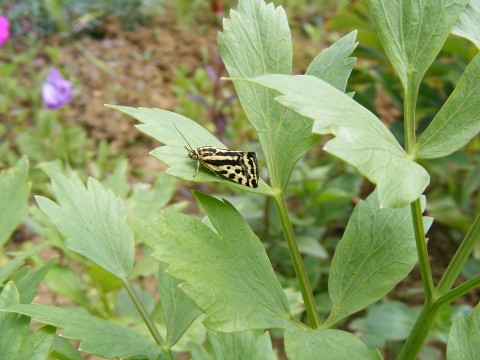
There is a lovage plant in the back corner of Marian Thrush's garden in Saffron Walden, Essex, that stands seven feet tall by the end of June. It is the size of a small tree. It has been in that corner since 1991, and it produces, by Thrush's estimate, more usable herb tonnage in a season than the rest of her kitchen garden combined.
Almost no one in the village grows lovage. Thrush is aware of one other plant in the parish, in the garden of a retired schoolteacher, and that one is descended from a division Thrush gave her in 2003.
Lovage, Levisticum officinale, is a hardy perennial in the carrot family that grows wild in the Apennines and was carried north and west by Roman and then monastic gardeners. It tastes like an intensified celery, with a yeasty, almost meaty depth that celery itself does not possess, and the same dominant aromatic compound, phthalides, that gives celery its characteristic flavor. A small handful of lovage leaves can replace a bunch of celery in any soup or stew.
The plant is, by the standards of the modern small garden, badly behaved. It grows enormous. It dies back completely in winter, leaving a bare patch. It self-seeds enthusiastically. Its flower head, an umbel up to ten inches across, attracts every pollinator in three parishes and then drops seed everywhere.
These are the reasons it has largely disappeared from cultivation. They are also, Thrush argues, surmountable.
The size problem solves itself if the plant is given a corner where seven feet is not a problem. Thrush's plant is at the north end of the garden, against a brick wall, where it shades nothing. It is staked once in May with three bamboo canes and twine, and otherwise it manages on its own.
The dieback problem is real and is the chief reason gardeners reject lovage. From November through March there is a patch of bare earth where the plant was. Thrush plants spring bulbs through the lovage crown, mostly small daffodils and snake's head fritillaries, which bloom in March and April while the lovage is still underground and have died back by the time the lovage shoots emerge in late April.
The self-seeding problem is genuinely a problem. A mature lovage plant produces several thousand viable seeds, and if any of them are allowed to mature and drop, the gardener will be pulling lovage seedlings out of the surrounding bed for years. Thrush manages this by cutting the flower head off before it sets seed, usually in late July. The bees get six weeks of flowering, the gardener gets no seedlings, and the plant puts its energy back into the rootstock.
What the plant returns for this small annual discipline is extraordinary.
From late April through October, Thrush has a constant supply of lovage leaves, stems, and seeds. She uses them more often than parsley, more often than thyme, more often than any other herb in the garden except chives.
The young leaves in May go raw into salads, finely chopped, in quantities small enough to season rather than dominate. They have a sharper, more peppery profile in spring than later in the year.
By June the leaves have matured and gone into soup. Thrush's lovage and potato soup is a household standard: a kilogram of potatoes, a litre of stock, a generous handful of lovage leaves added in the last five minutes of cooking, then blended. The lovage gives the soup the depth that celery would give, without the celery's stringiness and at a fraction of the volume.
The hollow stems become a kind of edible drinking straw for Bloody Marys in late summer, a use Thrush adopted after a visit to a restaurant in Berlin in 2008. The stems hold their flavor for about an hour in the drink, after which they go limp and are discarded.
The seeds, harvested when they are still green in early August, are pickled in white wine vinegar and used through the winter as a substitute for capers in fish dishes. Allowed to ripen on the plant, they dry to brown seeds that Thrush grinds into a kind of celery salt, mixing them with coarse sea salt for use on roast chicken.
The roots, lifted from a section of the plant every third autumn, are washed, peeled, and roasted with carrots and parsnips. They have a stronger, slightly bitter version of the leaf flavor and are an acquired taste that Thrush has only partly acquired.
The plant requires very little. It wants reasonably rich soil, full sun to partial shade, and adequate moisture in dry summers. Thrush mulches it in May with about three inches of well-rotted compost and waters it once a week in July if there has been no rain. She divides the crown every five or six years, when the centre begins to look tired, and uses the divisions to give away to anyone who will take them.
The giving away has been the harder part. Thrush has divided her plant perhaps eight times over the years, and most of the divisions have not thrived in their new gardens, not because the plant is difficult but because the new owners did not know what to do with it. A lovage plant in a garden where no one cooks with it is a large green object that requires staking, and is fairly soon dug up.
The plant that survived, in the retired schoolteacher's garden, lived because the schoolteacher was Welsh and remembered her grandmother's lovage soup. The flavor memory was already there, and the plant slotted into a kitchen that knew what to do with it.
Thrush thinks this is why lovage has nearly vanished from English gardens. It is not that the plant is difficult. It is that the dishes that needed it have largely been forgotten, and a herb without a use is, in any garden, an inconvenience.
She has written down her own lovage recipes in a small spiral notebook she keeps in the kitchen drawer, with the idea that one of her grandchildren may eventually want them. None of them have asked. The notebook waits.
The plant, meanwhile, comes up every April, reaches seven feet by June, and goes back underground in November. It will, Thrush thinks, outlast her. She is not sentimental about this. Lovage roots have been known to survive in abandoned gardens for fifty years and more, sending up shoots through brambles.
It is, she says, a plant for people who plan for the long view, or for no one in particular.