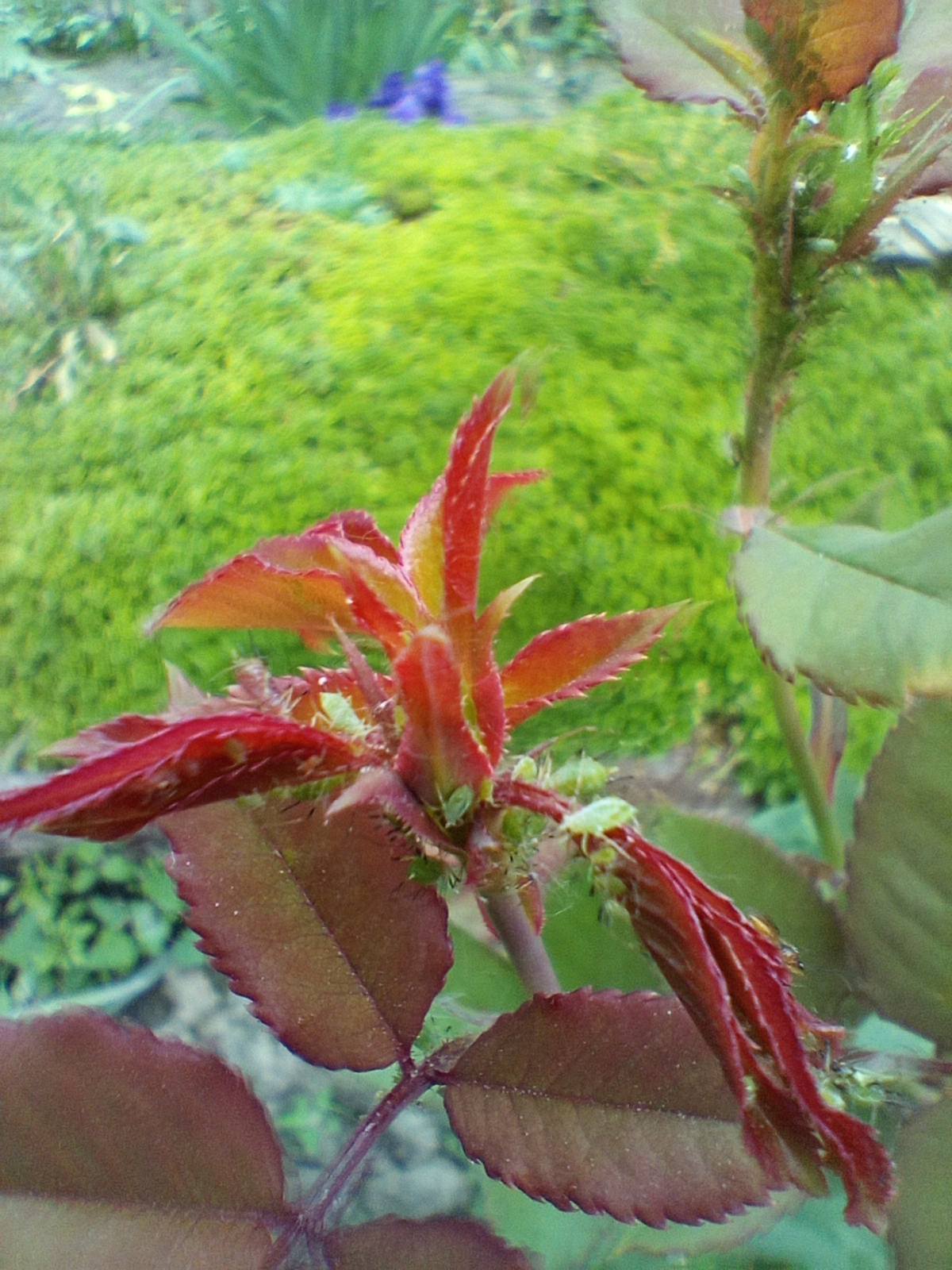
In the second week of November 2025, which is late spring in New Zealand, Caro Tildesley noticed a small colony of green aphids on the new growth of her peppermint in a sunny corner of her Wellington herb garden. She counted, on the worst-affected stem, about forty insects. By the following Saturday the colony had grown to perhaps two hundred. By the Saturday after that, it was largely gone.
Tildesley, who corresponds occasionally with this magazine about garden pests, kept notes through the three weeks. The notes are a small case study in the way an aphid infestation actually behaves in an unsprayed garden, and in the question every kitchen gardener faces when the pest first appears: act, or wait.
The aphids on Tildesley's mint were the peach-potato aphid, Myzus persicae, one of the most common and most polyphagous aphid species in temperate gardens. They had probably arrived from a neighboring property, where they overwinter on stone-fruit trees and disperse in spring onto a wide range of herbaceous hosts.
Mint, contrary to a persistent gardening myth, does not repel aphids. The volatile oils that give mint its flavor have some deterrent effect on certain insects, but Myzus persicae is not particularly bothered by them and will colonize mint readily when conditions are right.
In Tildesley's garden the conditions were right. The peppermint was in a flush of soft spring growth, the weather had been unusually warm and still for two weeks, and the local population of beneficial predators had not yet built up to its summer level.
Tildesley's first impulse, she admits, was to spray. She has a small bottle of insecticidal soap on a shelf in the shed for exactly this kind of moment, and a spray would have ended the infestation within forty-eight hours.
She did not spray, for two reasons. First, she keeps her mint deliberately near a patch of fennel that is allowed to flower for the predatory hoverflies, and a soap spray on the mint would have killed any hoverfly larvae already at work on the aphids. Second, she has run this experiment before, in 2021 and in 2023, and the outcome has been instructive.
In both previous years a spring aphid bloom on the mint resolved itself within two to three weeks without intervention, as the predator population caught up to the prey. In both years the mint produced a normal harvest from late November onward. The cost of waiting was a slightly tired-looking mint patch for three weeks. The benefit was a healthier predator population for the rest of the season.
The arithmetic of biological control is not intuitive, and most gardeners get it wrong. A spray ends the visible pest problem within days but also ends the local predator population, which has no prey to feed on. Three weeks after the spray the gardener has clean mint and no predators. Three weeks after that, the next aphid arrival, which is inevitable, finds an empty garden and reproduces freely.
Without the spray the gardener has a slightly aphid-damaged mint patch for three weeks and a population of hoverflies, ladybirds, lacewings, and parasitic wasps that prevents the next aphid arrival from establishing.
Tildesley's notes from the three weeks track this progression in detail.
Day one: forty aphids on one stem. No predators visible.
Day three: about eighty aphids across three stems. Tildesley notices a single ladybird, Coccinella septempunctata, on a neighboring fennel stem.
Day six: about one hundred and fifty aphids. The ladybird is back, joined by a second. A hoverfly, Melangyna novaezelandiae, is laying eggs on a leaf above the heaviest aphid colony.
Day eight: about two hundred aphids, and the first hoverfly larvae are visible. The larvae look like small green and brown maggots and are, gram for gram, among the most efficient aphid predators in the garden.
Day eleven: the aphid colony has stopped growing. Tildesley counts about a hundred and eighty aphids, six hoverfly larvae, three ladybird larvae, and two adult ladybirds. The first sign of parasitism appears: a single aphid mummy, the swollen tan-colored husk of an aphid that has been killed by a parasitic wasp larva developing inside it.
Day fifteen: the colony is in collapse. Tildesley counts about sixty live aphids and over thirty mummies. The hoverfly larvae are still feeding.
Day nineteen: about ten live aphids, dozens of mummies, several hoverfly larvae now pupating on the mint stems.
Day twenty-three: the colony is effectively gone. A handful of stragglers remain. The mint is producing new clean growth above the damaged area.
By day thirty the mint patch is back to full production. Tildesley harvests the first major mint cutting of the season, removing the damaged stems entirely and using the clean new growth.
The cost of the three weeks of patience is, on close accounting, modest. The mint patch lost perhaps five percent of its potential leaf area. The garden gained an established population of hoverflies, ladybirds, and parasitic wasps that will, through the rest of the spring and summer, keep aphid populations on the broader garden well below problem levels.
Tildesley emphasizes that the patient approach is not always the right one. There are situations in which intervention is justified: a heavy infestation on a seedling that cannot afford the leaf loss, a pest with no effective natural predator, a crop near harvest where the cosmetic damage is unacceptable.
For an established perennial herb in a garden with a working population of beneficial insects, patience is almost always cheaper and more effective than spraying. The challenge is that patience requires confidence in a system the gardener cannot directly see at work, and the visible problem — aphids on the leaves — is psychologically more compelling than the invisible solution — predators arriving.
Tildesley's suggestion for new gardeners is to allow at least one flowering plant within ten feet of every herb bed. Fennel, dill, yarrow, alyssum, and the small umbellifers attract and sustain the predator population that does the actual pest management. Without this nursery, the predators never arrive, and the patient approach genuinely does not work.
With it, the gardener mostly has to remember not to spray.
That, she says, is the hardest part.