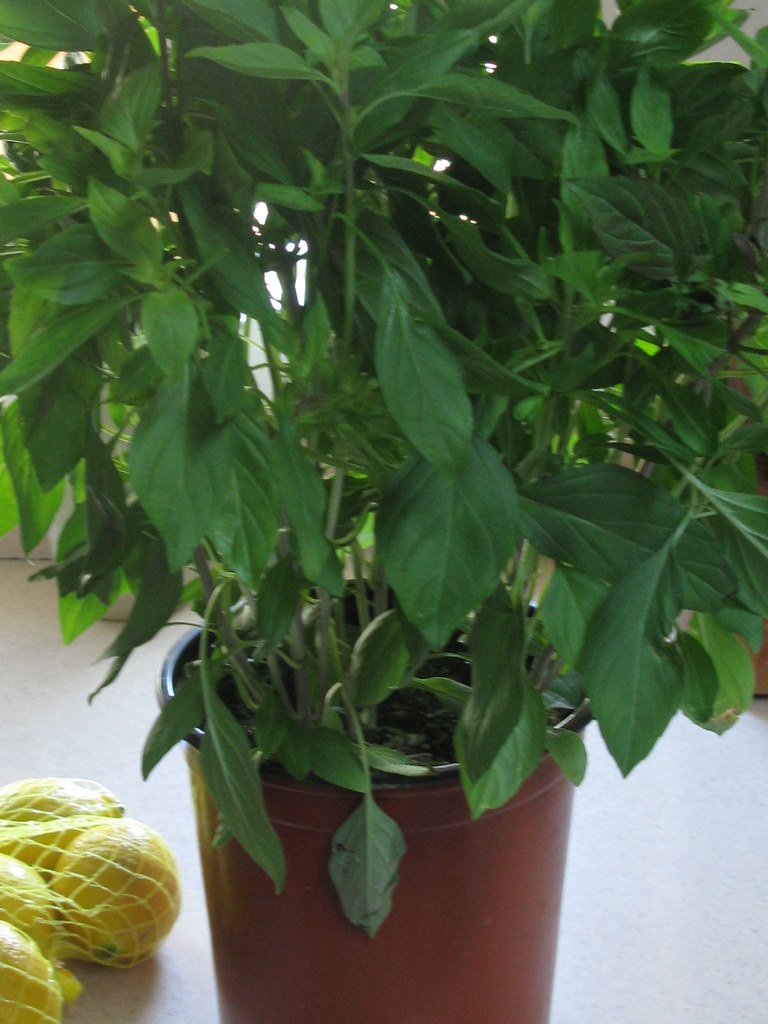
Daria Brennan grows four kinds of Thai basil in a sixteen-foot row at the back of her vegetable garden in Maplewood, New Jersey. The row faces southwest, the soil is a loamy clay that took six years of compost to soften, and the four cultivars are 'Siam Queen', 'Thai Magic', 'Queenette', and a seed-saved selection she calls simply 'the Hoboken plant', after the grandmother in Hoboken who first gave her cuttings in 2014.
The trial began in 2020, when Brennan realized she had been calling four visibly different plants the same name for several years and could not articulate the difference between them.
The four cultivars all belong to Ocimum basilicum var. thyrsiflora, the anise-scented Asian basil with purple stems, narrow leaves, and the candle-like flower spike that gives the variety its name. They share a flavor profile dominated by methyl chavicol and linalool, with the sweet licorice note that distinguishes them from sweet European basil. They diverge in everything else.
'Siam Queen', the All-America Selections winner from 1997, is the standard. It is the plant most American gardeners mean when they say Thai basil. The leaves are dark green with strong purple veining, the stems are nearly black, and the plant reaches about thirty inches tall in Brennan's garden by August. The flavor is forward and clean.
'Thai Magic', from Johnny's Selected Seeds, is a more recent selection. It is shorter, perhaps twenty-two inches, with smaller leaves and a tighter habit. It bolts later than 'Siam Queen' by about two weeks in Brennan's records. The flavor is similar but slightly less anise-dominant.
'Queenette' is the cultivar most often grown commercially for the New York Chinatown wholesale market. It produces larger leaves, holds well at harvest, and ships without bruising. Brennan grew it for the first time in 2022 after a friend who works at a wholesaler suggested it. The leaves are noticeably milder than 'Siam Queen', which Brennan first read as a defect and then, after a season, came to value for stir-fries where the basil is added in volume.
'The Hoboken plant' is the outlier. Brennan's neighbor, Mrs. Costanza, gave her three rooted cuttings in the spring of 2014 from a plant her own mother had brought from Taiwan in 1971. The plant has been propagated from cuttings every year since, never grown from seed, and Brennan suspects it is a stable old cultivar without a commercial name. The leaves are smaller than 'Siam Queen', the stems are more reddish than purple, and the anise note is muted in favor of a clove-cinnamon profile that Brennan has not found in any commercial cultivar.
In four years of side-by-side growing, Brennan has kept a small spiral notebook of observations.
The germination data is straightforward. All four germinate reliably at seventy-five degrees Fahrenheit on a heat mat, with 'Siam Queen' and 'Thai Magic' showing first true leaves at twelve days, 'Queenette' at fourteen, and the Hoboken plant, propagated from cuttings, rooting in water in seven to nine days.
Bolt timing matters more than germination in central New Jersey. 'Siam Queen' bolts first, usually by July 18. 'Thai Magic' follows around August 2. 'Queenette' holds until mid-August. The Hoboken plant bolts last, sometimes not until early September, which is the longest harvest window of the four. Brennan attributes this to either the cultivar's genetics or its origin in a slightly different latitude, or both.
Flavor evolves through the season. All four are at their most aromatic in the two weeks before bolting. After flowering, the leaves become slightly bitter and the anise note shifts toward something closer to fennel. Brennan harvests every five to seven days through the season and pinches flower buds as they form, which delays bolting by about a week without changing the eventual outcome.
For cooking, she has settled into a small private taxonomy. 'Siam Queen' goes into Thai red curry and the pho she makes every other Sunday in winter from frozen stock. 'Thai Magic' goes into pesto-style applications and her version of larb, where its slightly milder flavor lets the lime and chili lead. 'Queenette' goes into the high-volume stir-fries where she wants the herb to register without dominating. The Hoboken plant goes into a single dish: her grandmother-in-law's Taiwanese three-cup chicken, where the clove-cinnamon profile is exactly the note the recipe wants.
She freezes none of them. Thai basil, in her experience, loses everything in the freezer. She dries small quantities of 'Siam Queen' and 'Thai Magic' for winter use, though even dried Thai basil is a poor shadow of the fresh plant.
What she does instead is overwinter cuttings. Each year in late September she takes six-inch cuttings from each cultivar, strips the lower leaves, and roots them in glasses of water on a south kitchen windowsill. By November they have rooted, and she pots them into four-inch plastic pots in a light potting mix. They live on the windowsill through the winter, growing slowly, and provide just enough fresh leaves for a Sunday curry once a month.
The cuttings also serve as her insurance. Thai basil seed, in her experience, is not always true. A packet labeled 'Siam Queen' has, twice, produced a plant that looked more like Italian sweet basil than the anise-scented variety she expected. Cuttings carry the cultivar forward exactly, which is how the Hoboken plant has stayed Hoboken.
Brennan has thought about adding a fifth cultivar to the trial. 'Holy Basil', the related Ocimum tenuiflorum, is sometimes grouped with Thai basil but is genuinely a different species and a different plant. She grows two holy basil plants in a separate row and uses the leaves for tea rather than cooking.
She has also thought, more seriously, about giving up the trial. Four cultivars is a lot of row for a household garden, and three of the four are commercially available in any reasonable seed catalog. She could grow only the Hoboken plant and buy the others as needed.
She has not done this, and probably will not. The four-row trial has become its own small ritual, and the differences between the cultivars, which seemed academic in 2020, now seem to her like the central interesting fact about an ingredient she once thought she understood.
This year she planted out on May 14, two days after the last frost. The plants are in the ground, the row is mulched with straw, and Mrs. Costanza, who is ninety-one this June, has been informed that her grandmother's basil is up again.