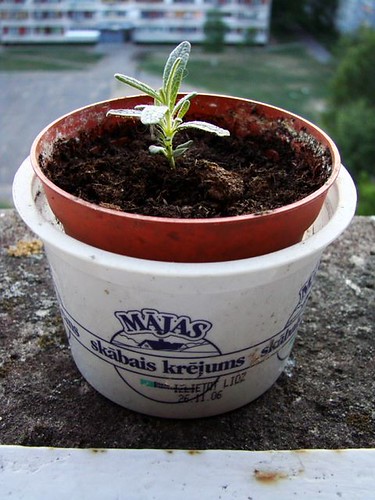
The rosemary on Cara Whelan's windowsill in Jamaica Plain is nineteen years old this March. It came from a four-inch pot at Russo's in Watertown in the spring of 2007, when Whelan was a graduate student and the apartment had three windows and one radiator that did not turn off.
It is, by her count, the only plant from that apartment that is still alive.
The cultivar is 'Tuscan Blue', upright and resinous, with the long spaced leaves that take pruning well. Whelan's plant has been root-pruned six times and repotted into the same terracotta vessel each time. The pot is twelve inches across and weighs about eighteen pounds when fully watered. She moves it twice a year, in October and again in May, and each move is a small event in the apartment.
There is a particular failure mode for indoor rosemary in New England, and Whelan has watched it claim other people's plants for two decades. The plant looks fine in November. By late January it is greyer than it should be, and the lower stems have begun to brown. By the end of February it is dead.
The cause is almost always the same. Forced-air or radiator heat dries the indoor air to twenty percent relative humidity or lower, and the rosemary, which evolved in the limestone hills of Provence and Liguria, simply transpires faster than its roots can replace the water. The leaves look intact while the xylem is already failing.
Whelan's solution is not elegant. It involves a small cool-mist humidifier, a south-facing window with the storm pane removed, and a saucer of pebbles kept wet under the pot. She runs the humidifier on a timer from 6 a.m. to 10 p.m. and refills it every other evening. The relative humidity around the plant, measured by a small hygrometer she clipped to the inside of the curtain, hovers between forty-two and fifty-one percent through the worst of February.
The window matters too. It faces almost due south, with a clear sight line over a low rowhouse roof, and the plant receives roughly five hours of direct sun on a clear winter day. Whelan keeps the inside pane clean. She does not pull the curtain at night.
Watering is the part that breaks most overwintered rosemary. The instinct, when a plant looks tired, is to give it more water. Rosemary almost always wants less. Whelan waters her plant when the top inch of soil is dry to the touch and the pot feels noticeably lighter than it did the day before. In a Boston January this is once every nine or ten days. In March it climbs to once a week. She uses room-temperature water and lets the saucer drain before returning it to the pebble tray.
She does not fertilize between October and March. The plant is not growing, and a flush of nitrogen in February only produces soft tissue the plant cannot support.
The pot lives in front of the window on a small wheeled trolley Whelan built from a remaindered cutting board and four casters from the hardware store on Centre Street. The trolley lets her turn the plant a quarter-turn each Sunday, which keeps the growth even. Without it the plant leans toward the glass by March and has to be staked.
There is one more thing she does, and it is the part most growers skip. In late January she takes a small pair of bypass scissors and prunes the plant by perhaps ten percent. She cuts the longest tips back to a leaf node, removes anything that has gone grey at the centre, and thins the densest interior growth so that air moves through the plant. The cuttings go into the kitchen, where they last several weeks in a glass of water and end up in roast potatoes and white bean soup.
The pruning seems counterintuitive. The plant is already stressed. But the alternative is worse. A rosemary that is allowed to brown unchecked through the winter often loses entire branches by March, and the recovery is slower than the recovery from a careful winter pruning.
Whelan repots in May, when the plant goes back outside to a small brick patio behind the building. She uses a fast-draining mix: two parts loam-based compost, one part horticultural grit, one part composted bark, with a small handful of crushed oyster shell worked in for the calcium and the slight alkalinity rosemary prefers. The pH she aims for is around 7.0.
The plant produces flowers in late April most years, small pale blue ones along the upper stems, and the bees in the building's back garden find them within hours. In May it goes onto the patio for the summer and grows perhaps four inches of new wood. By October it is back at the window.
There have been near-losses. In 2019 a cold snap caught the patio plants out, and Whelan brought the rosemary in at 9 p.m. with frost already on the lower leaves. She trimmed the damage, watered sparingly, and waited. The plant pushed new growth from the lower stem six weeks later. In 2022 a leak in the apartment above flooded the south window and the pot sat in standing water for forty-eight hours. The lower roots rotted. She unpotted the plant, washed the rootball, trimmed the dead tissue, and repotted into fresh fast-draining mix. It survived but did not flower that spring.
Other people in Whelan's building have tried to overwinter rosemary on her recommendation, and the results vary. The most common failure is the radiator. A plant placed within four feet of a cast-iron radiator, without a humidifier and a hygrometer, will not survive a Boston winter no matter how careful the watering. The second most common failure is the north window, which delivers perhaps an hour of weak indirect light and is not enough.
The third failure is impatience. Indoor rosemary in winter does not look healthy. It looks like a plant that is, at best, holding on. Growers used to the lush summer growth read winter dormancy as decline and intervene, and the intervention is what kills the plant.
Whelan does not claim her method is the only one. A friend in Somerville keeps her rosemary in an unheated mudroom that hovers around forty degrees Fahrenheit all winter, and the plant goes effectively dormant and needs water perhaps once a month. That works too. The principle is the same: rosemary wants cool, bright, dry, and undisturbed.
The plant on the Jamaica Plain windowsill has produced, by Whelan's rough count, perhaps eighty roast chickens, a hundred loaves of focaccia, and an uncountable number of glasses of infused gin. It has outlasted three jobs, two apartments in the same building, and a marriage.
In a city where most overwintered herbs are an annual purchase, that is a small kind of permanence.